This is the post in this series where my old course notes are most out of date — and honestly, that’s exactly why it’s worth writing. Going back through the original slides, they describe Ethereum (the version for ETH 2.0) as a future, three-phase upgrade, with sharding as part of “phase two,” and a supply model presented as a set of 2021 forecasting scenarios. All of that has since actually happened, and it happened differently than the roadmap on those slides predicted. Let’s do the full comparison.
The Problem, As It Was Taught: The Blockchain Trilemma
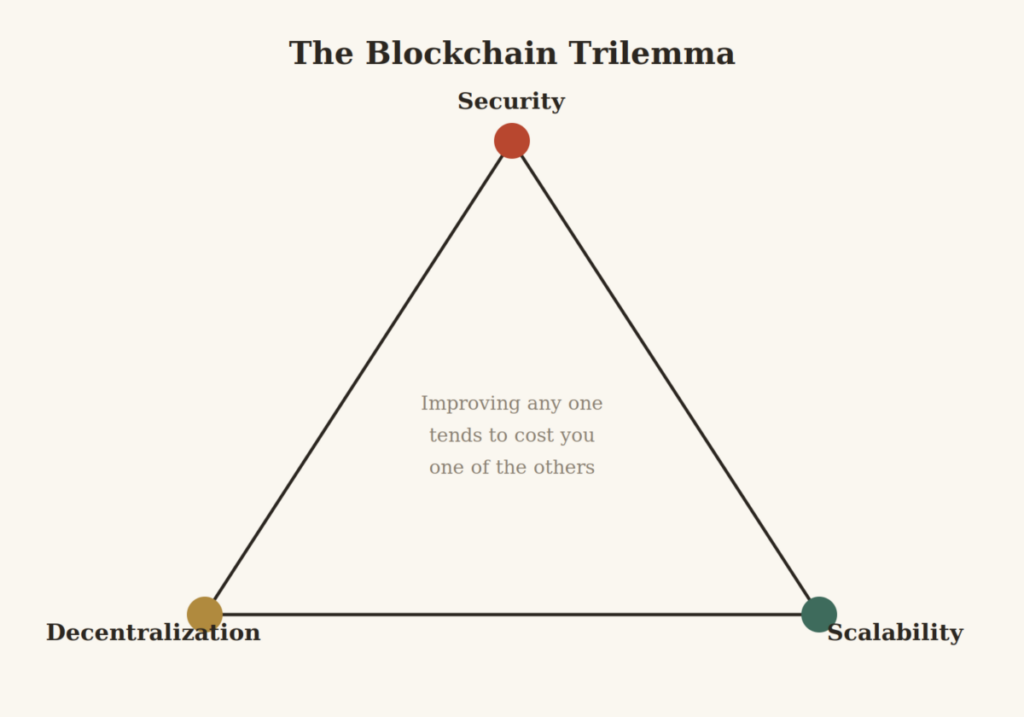
The framing hasn’t aged a day: any blockchain has to balance three properties — decentralization, security, and scalability — and improving one tends to come at the cost of another.
The blockchain trilemma — push too hard on any one corner, and one of the other two tends to give.
Ethereum’s specific version of this problem, as described in the original material: the network could handle roughly 15 transactions per second, compared to Visa’s tens of thousands. Simply raising the block size to fit more transactions would mean nodes need to store and process more data, which pushes out smaller participants and centralizes the network into the hands of a few large, well-resourced operators — the opposite of the goal.
Sharding was presented as the fix: break the blockchain into smaller partitions (“shards”), so no single node has to process the entire network’s transaction load, only its own shard. This was slated as part of a broader “Ethereum 2.0” three-phase rollout.
What Actually Happened
Phase one landed almost exactly as planned. On September 15, 2022, Ethereum completed The Merge — switching its consensus mechanism from Proof-of-Work (miners, like Bitcoin) to Proof-of-Stake (validators, who lock up ETH instead of burning electricity to secure the network). This cut Ethereum’s energy consumption by roughly 99.95% overnight, and it’s the single biggest thing that changed since this course was taught.
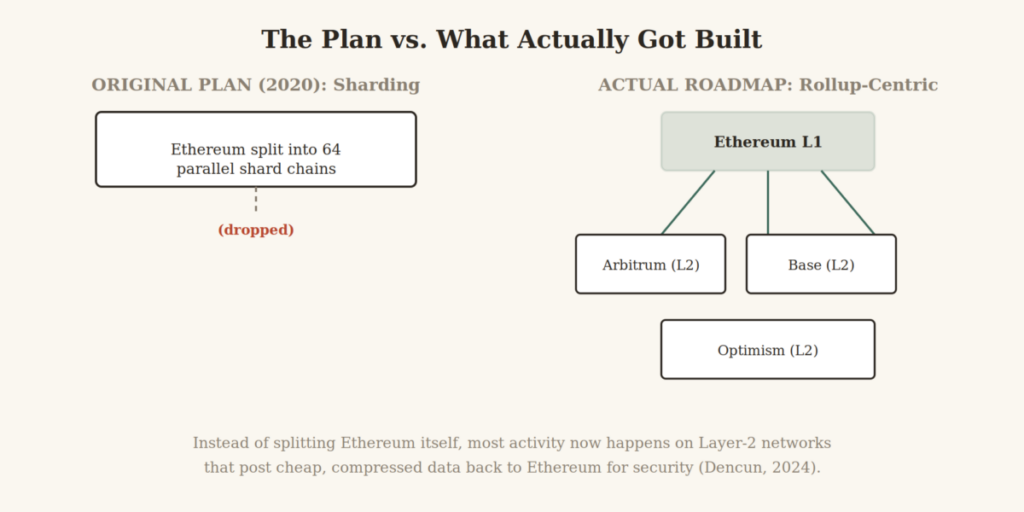
Phase two — sharding — didn’t happen the way it was originally planned, and that’s the most important correction in this entire post. The original 64-shard-chain architecture was ultimately dropped. In its place, Ethereum’s developers converged on a different strategy entirely: a “rollup-centric roadmap.” Instead of scaling the base Ethereum layer directly, the actual scaling happens on Layer-2 networks — Arbitrum, Optimism, Base, and others — which bundle up thousands of transactions off-chain and post a compressed summary back to Ethereum for final settlement and security. Ethereum’s job shifted from “process every transaction” to “provide cheap, secure data availability for networks that process transactions on its behalf.”
The original plan split Ethereum itself into 64 shards. What actually got built: Ethereum as a secure settlement layer underneath a growing ecosystem of Layer-2 rollups.
That shift is why the next major upgrades looked different from the original sharding plan:
April 2023 — Shanghai/Shapella: enabled validators to actually withdraw their staked ETH for the first time (a genuinely important, underrated upgrade — staked ETH had been locked with no exit since the Merge).
March 2024 — Dencun: introduced “blobs” (via a proposal called EIP-4844) — cheap, temporary storage specifically for Layer-2 data, which dramatically cut fees for rollups almost overnight. This is widely considered the first real step toward the original sharding vision, just implemented very differently — commonly called “proto-danksharding.”
May 2025 — Pectra: the largest upgrade since the Merge, bundling 11 separate proposals. The headline changes: raising the maximum stake per validator to 2,048 ETH (making institutional and pooled staking dramatically more efficient), and account abstraction (letting regular wallets behave more like programmable smart contracts — enabling things like sponsored transactions and better recovery options).
December 2025 — Fusaka: added a further scaling mechanism (PeerDAS) building toward full “danksharding.”
Looking ahead — Glamsterdam (targeted Q4 2026) and Hegotá (2027): continued steps toward the original scaling vision, just arriving years later than the original three-phase plan implied, and via a materially different architecture than “shard chains.”
What Happened to the Supply Story?
The original slides presented ETH’s future supply as a set of 2021 forecasting scenarios tied to two then-future events: the EIP-1559 fee-burning mechanism and “the merge.” Both have long since happened. EIP-1559 (activated in August 2021, just after this course was taught) burns a portion of every transaction fee instead of paying it entirely to miners/validators — meaning that during periods of high network activity, ETH issuance can actually turn net-negative, making the asset deflationary in practice rather than just in theory.
This dynamic has become a genuine talking point in how Ethereum is discussed as an asset class, though — worth being precise here — whether ETH nets out inflationary or deflationary in any given period depends entirely on how much fee-burning activity is happening at the time, so treat any specific supply figure you see quoted as a snapshot, not a permanent state.
The Honest Takeaway
If you’d read only the original course slides and nothing since, you’d expect Ethereum in 2026 to be a single, larger blockchain processing everything itself via sharding. What actually exists is a two-layer system: a highly secure, decentralized settlement layer (Ethereum mainnet) with the actual high-volume activity happening on a growing ecosystem of Layer-2 networks that inherit its security. It’s a genuinely different architecture than what was on the roadmap — and arguably a more pragmatic one, since it let scaling improvements ship incrementally (Dencun, Pectra, Fusaka) rather than waiting on one enormous, high-risk architectural rewrite.
This is Part 6 of a 15-part series. Part 7 steps back from the technical deep-dive to ask a more strategic question: when do you actually need a blockchain at all? and Part 1 is here
Bitcoin reaches consensus without any central authority through a specific set of rules — this is the post that ties Parts 2 and 3 together into an actual working system. You now know how keys and signatures prove ownership. But proving you signed a transaction doesn’t answer a much harder question: in a network of…
The Cryptography That Actually Powers Bitcoin Bitcoin cryptography is usually explained with hand-wavy metaphors, so let’s not do that here. Most explainers wave their hands at “cryptography secures the blockchain” and move on. I’d rather not do that — partly because the actual math is genuinely elegant, and partly because understanding it changes how you…
What is blockchain, really? I studied this material properly, in an MBA-level ‘Cryptoeconomics & Blockchain Technologies’ course a few years back, and I’ve been sitting on the notes ever since. The goal of this series isn’t to rewrite a blockchain textbook. It’s to take what I learned then, separate the concepts that aged well from…