The MIMIC-IV dataset is the quiet, unglamorous foundation behind both of my published papers. Both of my papers — the one on whether LLMs can safely explain radiology reports, and the follow-up on whether radiologists can actually catch it when they can’t — used the same underlying data source. I’ve referenced it in passing in both posts without ever really explaining what it is, where it came from, or what it actually takes to get your hands on it. Worth fixing that, especially since I think more people writing about “AI in healthcare” should actually know this dataset exists, rather than speculating about clinical data from the outside.
What the MIMIC-IV Dataset Actually Is
MIMIC-IV stands for Medical Information Mart for Intensive Care, and it’s a large, de-identified database of real electronic health records from Beth Israel Deaconess Medical Center (BIDMC) in Boston. It’s built and maintained by the MIT Lab for Computational Physiology and hosted on PhysioNet, a research data repository that — as of 2026 — has been running for 25 years.
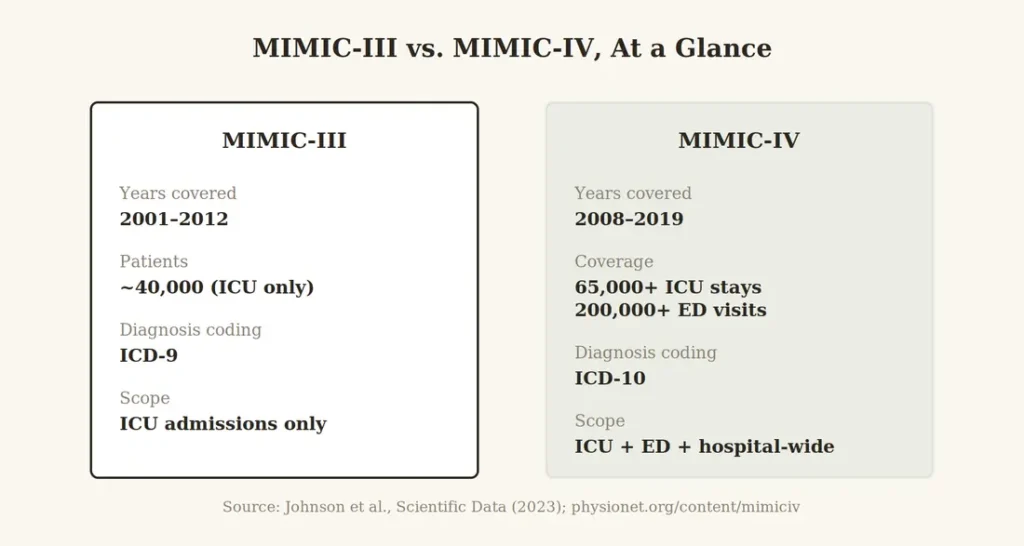
The current release (v3.1) covers patients treated between 2008 and 2019: over 65,000 ICU admissions and more than 200,000 emergency department visits, coded using ICD-10. It’s the successor to MIMIC-III, which covered an earlier, smaller slice of the same hospital’s ICU population.
MIMIC-III was ICU-only, coded in ICD-9. MIMIC-IV expanded to emergency department and hospital-wide data, coded in ICD-10 — a meaningfully bigger and more recent dataset.
What actually makes MIMIC-IV valuable for research isn’t just its size — it’s that it’s real clinical data, not a synthetic or simulated stand-in. Vitals, lab results, medications, diagnoses, free-text clinical notes, and — the specific piece my own research used — radiology reports, all drawn from actual patient encounters and then carefully de-identified before release. That’s a genuinely hard thing to build and maintain responsibly, which is part of why so few datasets like it exist publicly at all.
How to Actually Get Access
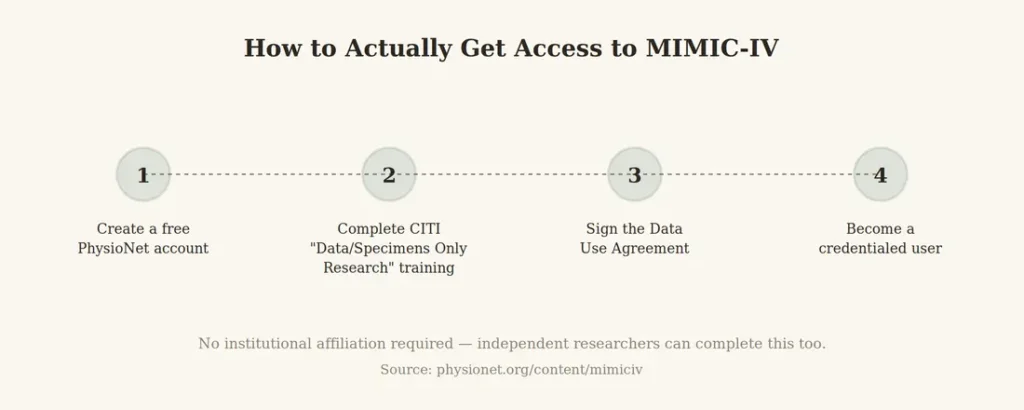
This part doesn’t get explained clearly very often, so here’s the real process, since I’ve been through it myself:
The four-step process to get credentialed access to MIMIC-IV — no institutional affiliation required.
A few things worth knowing about this process specifically:
You don’t need to be affiliated with a hospital or a big-name university. The CITI “Data or Specimens Only Research” training course is open to independent researchers, and PhysioNet’s credentialing process is built around completing that course and agreeing to the terms — not around your institutional letterhead.
The Data Use Agreement is the part to actually read carefully, not skim. It’s a real legal commitment governing how you can use, store, and (critically) not redistribute the data. If you ever build something derived from MIMIC-IV that you want to share publicly, PhysioNet has a specific naming convention for it — your project has to include “Ext” in the name (short for “extracted” or “extended”), and if you’re releasing the derived dataset itself, it has to go back through PhysioNet under the same access controls, not onto a public GitHub repo or Hugging Face.
It’s genuinely free. No paywall, no data licensing fee — the barrier is the training and the agreement, not money.
Why This Specific Dataset Has Become the Default for LLM Healthcare Research
Here’s what I didn’t fully appreciate until I went looking into this for this post: MIMIC-IV isn’t just widely used — it’s become the specific foundation for an entire growing sub-category of datasets built explicitly to test LLMs in clinical settings. Browsing PhysioNet’s own listings, there are now multiple “MIMIC-IV-Ext” datasets purpose-built for this: one specifically curating cases to evaluate LLMs on clinical decision-making for abdominal pathologies, another extracting and extending over 9,000 real cases specifically to test how well LLMs support triage, specialist referral, and diagnosis.
That’s not a coincidence, and it’s exactly the lane my own two papers sit in — using MIMIC-IV radiology reports and MIMIC-IV-Note to test how LLMs handle patient-facing medical communication, and then testing whether human experts can catch it when they get it wrong. If you’re doing any kind of serious research on LLMs in healthcare right now, there’s a good chance you’re either using MIMIC-IV directly or using one of these growing “Ext” derivatives built on top of it.
Why Open Data Like This Actually Matters
It’s easy to take a resource like this for granted once you’ve used it a few times, so it’s worth saying plainly: the fact that real, de-identified hospital data is available to any credentialed researcher — not just people inside a specific hospital system, not just people at a handful of elite institutions — is a genuinely big deal for how fast this field can move. Every claim in my own published papers is checkable, in principle, by anyone willing to go through the same four-step process I did. That’s a meaningfully different standard than research built on data nobody else can see.
If you’re working on anything in digital health and haven’t looked into PhysioNet yet, it’s worth the afternoon it takes to get credentialed — long before you actually need the data for a specific project.
One thing I’d genuinely like to see more of: resources like this still aren’t common in Korea. From what I’ve seen, getting access to real, de-identified clinical data here usually means being affiliated with the specific hospital or institution that holds it, going through a heavier case-by-case approval process, and often working with the data only on-site rather than downloading it under an open credentialing system like PhysioNet’s. I’d love to see more MIMIC-IV-style open datasets emerge here — the kind any credentialed researcher can build on, not just someone already inside a specific hospital system. It would genuinely speed up how fast digital healthcare research in Korea can move.
On a related note: I’m currently working on a new research project using open datasets like MIMIC-IV, this time looking at digital phenotyping — inferring health-relevant patterns from passive behavioral data rather than clinical notes and reports. Still early, but I’ll share more once there’s something concrete to report.
This is part of my ongoing Lab Insights series on digital healthcare and AI. If you’ve used MIMIC-IV or one of its derivative datasets for your own research, I’d be curious what you built — let me know in the comments.
This one’s personal — it’s my own peer-reviewed research, published this year in Healthcare. I’ve spent most of this blog reviewing other people’s work and other people’s technology. This time I get to walk you through mine. Here’s where it actually started. Ordinary people are already asking AI chatbots questions about their own medical information…
Today I was at COEX for MEeT 2026 — something a little different from my usual beat. Not a trade show floor, but a conference specifically about the messy, unglamorous process of turning a clinical idea into an actual company. This was its first-ever run. I want to be upfront about why this one hit…
KHF 2026 — the K-Hospital + HealthTech Fair — was held this week at COEX in Seoul, and I made a point of pre-registering and going. I studied digital healthcare myself, and I wanted to see with my own eyes where Korea’s medical health-tech industry actually stands right now, beyond the press releases. One honest…
Radiologist oversight of AI errors is the exact question this study set out to quantify. My last post walked through my main study on whether LLMs can safely explain radiology reports to patients — and one of the more uncomfortable findings was the calibration deficit: the models’ most dangerous errors were the ones delivered with…