Today I was at COEX for MEeT 2026 — something a little different from my usual beat. Not a trade show floor, but a conference specifically about the messy, unglamorous process of turning a clinical idea into an actual company. This was its first-ever run.
I want to be upfront about why this one hit differently than the health-tech fair I covered a few weeks back. I’ve actually lived this exact gap before — as a startup CSO who spent years chasing funding rounds, regulatory approval, and hospital partnerships for a digital health product, before moving into research on how AI actually behaves once it reaches a patient. Most of today’s audience was seeing this process from one side. I’ve now seen it from both, and that’s the lens this post comes from.
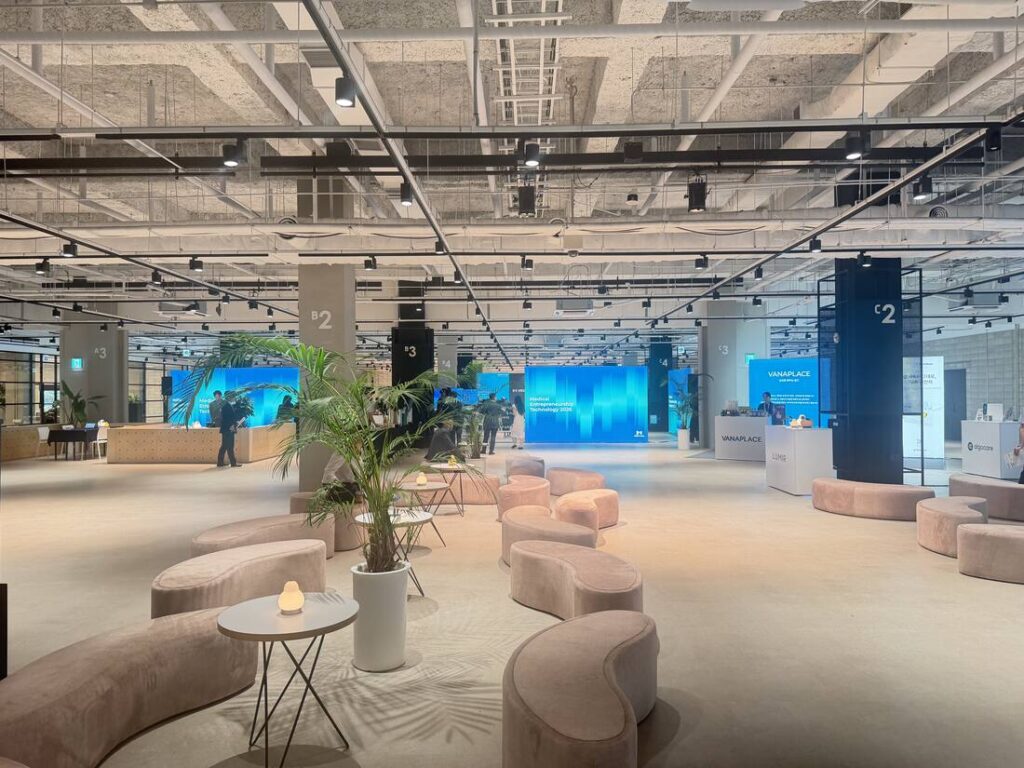
The Platz at COEX — MEeT 2026’s venue for its first-ever edition.
What MEeT 2026 Actually Is
MEeT stands for Medical, Entrepreneurship & Technology, and it’s pitched as something genuinely new in the Korean conference landscape — not an academic conference (research-presentation focused), not a trade show (finished-product focused), and not a pure startup pitch event (fundraising focused). It’s specifically built around the process in between: how a clinical problem identified by a doctor actually becomes a funded, licensed, market-ready technology.
It was hosted by the Ilsong Foundation, the Korea Convention & Exhibition Industry Research Institute, and IZ PMP, with Korea Investment Partners and the Korea Biotechnology Industry Organization backing it. The organizers have been explicit that the ambition is something like a Korean equivalent to a healthcare-focused CES — bringing clinicians, technologists, investors, regulators, and hospital administrators into the same room, rather than letting each group run its own separate conference circuit.
The gap this conference exists to address is a familiar one to anyone who’s tried to move a piece of medical technology from a research finding to something a hospital will actually adopt: a good clinical insight and a working prototype are nowhere near the same thing as a funded, regulator-approved, hospital-validated product, and most of the distance between those two points has nothing to do with the technology itself.
Global Insight I: From Lab to Market, With Stanford SPARK
The day’s keynote session was built around Kevin Grimes, Professor of Chemical & Systems Biology at Stanford and Co-Director of SPARK, Stanford’s translational research program. SPARK’s whole model is deceptively simple: pair academic researchers with industry mentors early, specifically to push a lab discovery toward an actual product rather than letting it stall out as a publication. Since its 2006 launch, SPARK has moved roughly half of its supported projects into a company license, and more than half of those went on to enter actual clinical trials — a genuinely strong conversion rate for translational research, and the program has since been adopted by 60-plus universities and institutes across 20-plus countries.
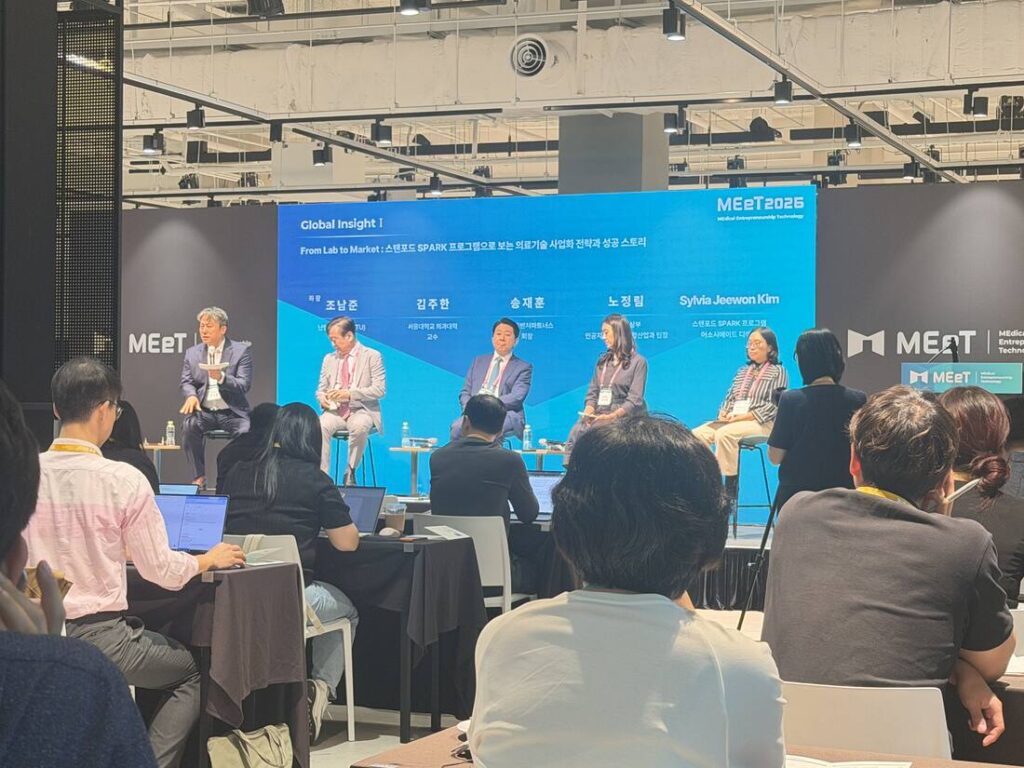
Global Insight I: ‘From Lab to Market’ — the panel following Kevin Grimes’ keynote, discussing Stanford SPARK’s model for medical technology commercialization.
The keynote fed directly into a panel discussion — moderated by Professor Nam-Joon Cho of Nanyang Technological University, with Professor Ju-Han Kim of Seoul National University College of Medicine, a government official working on health-tech policy, and Sylvia Jeewon Kim, Associate Director of Stanford SPARK, all weighing in. This is also the session where I got to meet 송재훈 (Song Jae-hoon) — he was on this same panel, and my advisor, who was attending with me, knew him and introduced us directly. I’m genuinely grateful for that introduction, and for the perspective he shared afterward on what actually determines whether a Korean digital-health venture survives past its first few years.
Global Insight II: The Decisions That Changed the Stage
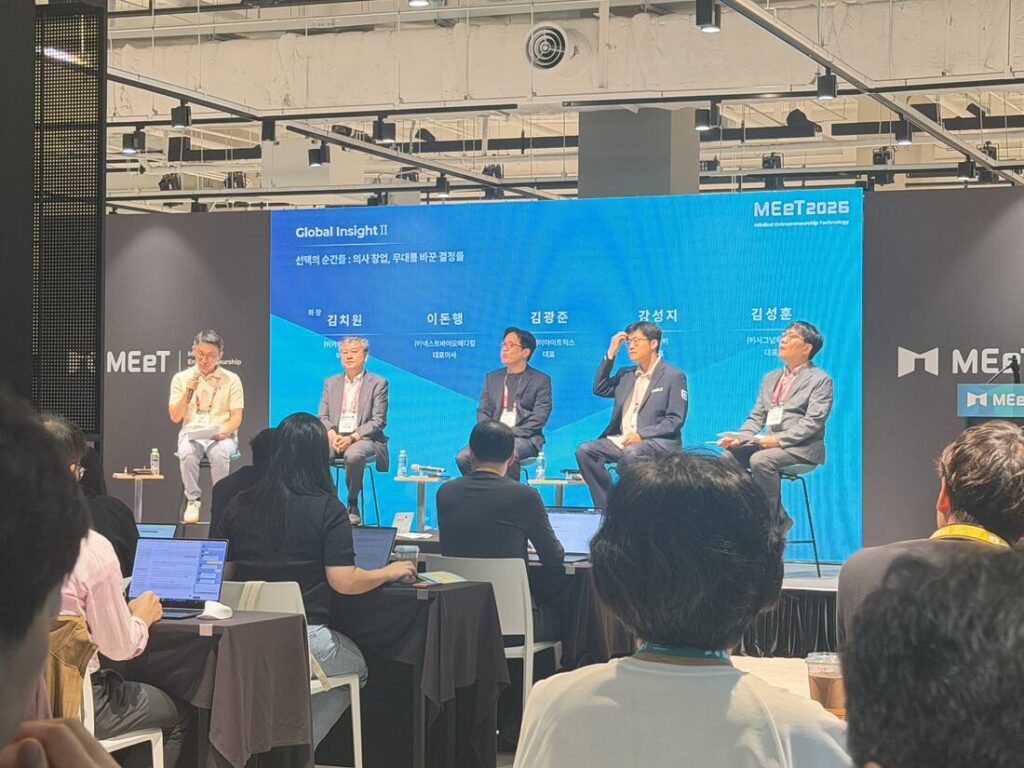
The second keynote-adjacent panel took a more personal angle — “선택의 순간들” (Moments of Choice), built around physicians who left clinical practice to found companies, walking through the specific decision points that pushed them to make that leap.
Global Insight II — a panel of physician-founders discussing the specific moments that led them from clinical practice into entrepreneurship.
What struck me listening to this one: none of the panelists described their pivot as a single dramatic moment. It was consistently framed as a slow accumulation of the same frustration — watching a real clinical gap go unaddressed for years because no existing company had a reason to build for it — until building it themselves stopped feeling optional.
The Round Tables: Where the Real Value Was
The panels were useful, but the part of MEeT 2026 I’d actually recommend to anyone attending next year is its Round Table (RT) format — dozens of small, simultaneous tables running throughout the afternoon, each hosted by a specific speaker on a specific topic, with attendees free to walk up and sit down at whichever ones matched their interests. It’s a genuinely different experience from watching a panel from the audience: instead of one-way broadcasting to a few hundred people, you get to actually sit across from someone and ask the question you came with.
This is how I ended up at two separate small-group conversations that afternoon: one with Man-soon Hwang, CEO of Korea Venture Capital, hosting a table specifically on what venture capital actually looks for in a biotech/healthcare venture, and another back with Jae-Hoon Song, CEO of Mint Venture Partners, going deeper on the same lab-to-market questions from the earlier panel in a much smaller, more direct setting. Neither was a formal 1:1 — a handful of other attendees were at each table — but both were close enough to one that I got real, specific answers rather than rehearsed stage answers, on questions I’d been sitting with since my own time.
That’s the structural thing I think MEeT got right for a first-year event: most conferences optimize for how many people can hear a big name speak. This one optimized for how many people can actually talk to one.
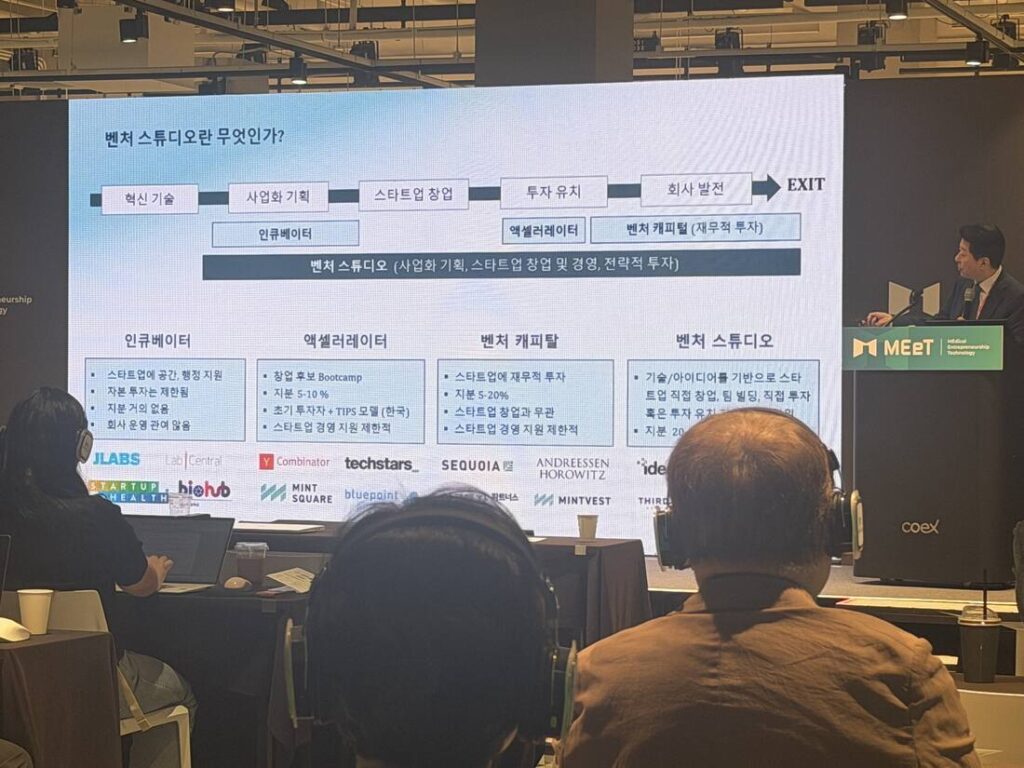
One of the afternoon’s practice-session slides — part of the broader mix of round tables and sessions running in parallel throughout the day.
What This Connects To
A few weeks ago I wrote about visiting KHF 2026, Korea’s hospital and health-tech fair, and I flagged a section on the regulatory and funding landscape as the part I found most useful — more useful, honestly, than another product demo. MEeT 2026 is basically an entire conference built around exactly that thread: not “what does the technology do,” but “what actually determines whether it survives contact with the market.”
That’s also, not coincidentally, the same question underneath my own published research — whether an AI system that performs well in a controlled study can actually be trusted once it’s deployed in front of a real patient, with all the messy human and institutional oversight (or lack of it) that implies. Today’s conference was the business and policy side of that same coin.
This is part of an ongoing series covering Korea’s digital health and AI landscape firsthand. If you’re building something in this space and were also at MEeT 2026 today, I’d genuinely like to hear how you read the sessions differently — let me know in the comments.
The MIMIC-IV dataset is the quiet, unglamorous foundation behind both of my published papers. Both of my papers — the one on whether LLMs can safely explain radiology reports, and the follow-up on whether radiologists can actually catch it when they can’t — used the same underlying data source. I’ve referenced it in passing in…
This one’s personal — it’s my own peer-reviewed research, published this year in Healthcare. I’ve spent most of this blog reviewing other people’s work and other people’s technology. This time I get to walk you through mine. Here’s where it actually started. Ordinary people are already asking AI chatbots questions about their own medical information…
Radiologist oversight of AI errors is the exact question this study set out to quantify. My last post walked through my main study on whether LLMs can safely explain radiology reports to patients — and one of the more uncomfortable findings was the calibration deficit: the models’ most dangerous errors were the ones delivered with…
KHF 2026 — the K-Hospital + HealthTech Fair — was held this week at COEX in Seoul, and I made a point of pre-registering and going. I studied digital healthcare myself, and I wanted to see with my own eyes where Korea’s medical health-tech industry actually stands right now, beyond the press releases. One honest…