Radiologist oversight of AI errors is the exact question this study set out to quantify. My last post walked through my main study on whether LLMs can safely explain radiology reports to patients — and one of the more uncomfortable findings was the calibration deficit: the models’ most dangerous errors were the ones delivered with the most confidence, offering no built-in warning sign to a reader. That naturally raises a follow-up question: if the plan is “have a human expert review the AI’s answer before it reaches a patient,” how good are humans actually at catching these errors?
That’s the entire question this second, more focused study set out to answer.
A Quick Note on Access
This one sits behind a paywall for most readers — it’s published under a standard Springer license, not open access, so if you go looking you’ll only see the abstract for free. Since it’s my own paper, though, I’m writing this post from the complete manuscript, not just what’s publicly visible. If you want to verify anything directly, the link at the bottom gets you to the abstract; full text requires institutional or paid access.
The Setup
Three board-certified radiologists — deliberately chosen from different subspecialties (Reader 1: abdominal imaging, 8 years post-certification; Reader 2: thoracic imaging, 12 years; Reader 3: musculoskeletal imaging, 6 years) — independently reviewed 1,200 LLM-generated answers (400 from each of three different models: GPT-4o mini, Claude 3.5 Sonnet, and Grok) to simulated patient questions drawn from 187 MIMIC-IV radiology reports. This was a 10% stratified sample pulled from the larger 12,000-answer corpus behind my first study, and it used the same underlying corpus and question-generation framework as my first study, but this was a separate evaluation with a different explicit goal: measuring human detection accuracy, not the AI’s own accuracy.
Each reader scored every answer on the same 1–3 scale as before: 1 for a clinically significant error, 2 for something incomplete or ambiguous, 3 for accurate — blinded to which LLM had generated each answer, and blinded to each other’s scores. The reference standard was based on the three readers’ independent assessments, with a senior radiologist adjudicating any discrepant or potentially safety-critical case using the original report, the patient question, the LLM’s response, and the readers’ own scores together.
Of the 1,200 answers reviewed, 113 (9.4%) were genuinely deficient by that reference standard — including 18 outright clinically significant errors (1.5%) and 95 incomplete or ambiguous responses (7.9%).
Finding: Radiologist Oversight of AI Errors Isn’t Reliable With a Single Reader
Reader sensitivity — the percentage of genuinely deficient answers a given radiologist actually caught — ranged from 81.4% to 96.5% across the three readers. It’s tempting to read that spread as “some readers are just better than others,” but that’s not really the point the paper makes, and I don’t want to overstate it here either: all three were board-certified radiologists with 6–12 years of experience, and the paper’s own read is that this variability reflects differences in reading strategy and attention on this particular task, not a qualification gap. The real takeaway isn’t about ranking the readers — it’s that even the better-performing individual readers still missed real deficiencies on their own, including one or two of the 18 most clinically significant errors each.
Averaged across all three, a single radiologist reviewing this kind of AI-generated content missed about 12.4% of deficient answers on their own (ranging from 3.5% for the best-performing reader to 18.6% for the least — Table 2, if you’re checking the paper directly). That’s the number that actually matters here, and it isn’t a knock on radiologists specifically — it echoes a well-established phenomenon in diagnostic imaging itself, where missed findings on scans follow a similar pattern, and it’s exactly why double-reading protocols already exist in fields like breast cancer screening. Reviewing AI-generated text for subtle omissions and misinterpretations turns out to demand the same kind of sustained, error-prone vigilance as reading the images themselves — regardless of who’s doing the reviewing.
Finding: A Second Reader Closes Almost the Entire Gap
Adding a second independent reader dropped the average miss rate from 12.4% to 0.6%. A third caught everything in this dataset.
This is the headline result, and it’s a genuinely encouraging one. Requiring just two independent readers dropped the average miss rate from 12.4% down to 0.6% — no dual-reader pair missed more than a single deficiency out of 113. A third reader caught everything remaining in this dataset.
Put simply: a single radiologist checking an AI’s patient-facing answer is a real safety layer, but a meaningfully leaky one — and it’s worth being precise about what “safer” means here rather than overselling it. In this dataset, dual review reduced the observed miss rate from 12.4% to 0.6%; whether that level of redundancy is practical or cost-effective across a real clinical workflow is a separate question the study wasn’t designed to answer (the paper itself flags this directly as needing further study).
What the data does support clearly is why a second reader helps. Of the 40 deficiencies (35.4% of all 113) that fooled at least one reader into rating them “accurate,” 38 were missed by exactly one reader and only 2 were missed by two readers. Not a single deficiency slipped past all three. Among the 18 clinically significant errors specifically, only 3 (16.7%) were missed by anyone at all. That pattern — misses concentrated in one reader at a time rather than shared across readers — is exactly the condition under which adding a second independent reviewer helps the most.
One case from the paper makes this concrete. A patient with metastatic kidney cancer had an incidental coronary calcification on a chest CT, and asked the AI how serious it was. The AI’s answer called it “not immediately serious” — a characterization the report itself didn’t support. One of the three readers scored that answer a 3 (accurate) on first pass; the other two caught it (scores of 1 and 2). That’s the whole argument for dual review in a single example: not that any one reader was careless, but that a plausible-sounding wrong answer can slip past a specific reader on a specific day, and a second independent set of eyes is what catches it.
A Finding I Didn’t Expect: Fewer Errors Doesn’t Mean Easier-to-Catch Errors
Here’s a genuinely counterintuitive result buried in the model-level breakdown. Within this 1,200-answer sample, GPT-4o mini produced far more deficiencies than the other two models — 70 out of 400 (17.5%), compared to 22 for Claude 3.5 Sonnet (5.5%) and 21 for Grok (5.3%), consistent with the accuracy gap from my first study.
But when you ask “of the deficiencies each model did produce, how many slipped past at least one reader,” the ranking flips: 59.1% of Claude’s deficiencies were missed by someone, versus 47.6% for Grok and only 24.3% for GPT-4o mini (χ² = 10.6, p = 0.005). In other words, GPT-4o mini’s deficiencies — despite being far more numerous — were comparatively easy for readers to catch, while Claude’s rarer deficiencies were more likely to slip through undetected. One possible explanation is that a generally stronger model produces fewer but more subtle failures — responses that stay fluent and plausible even when they’re wrong, echoing the fluency problem from my first study. But I want to be clear that’s my own speculation, not something this study directly tested: the paper explicitly flags this analysis as hypothesis-generating rather than a comparative performance claim, given the small counts involved (21–70 deficiencies per model).
Finding: Where You’re Reading Matters as Much as Who’s Reading
This is the part of the paper that wasn’t in the public abstract at all, and it’s arguably the most practically useful finding for anyone actually building a deployment plan.
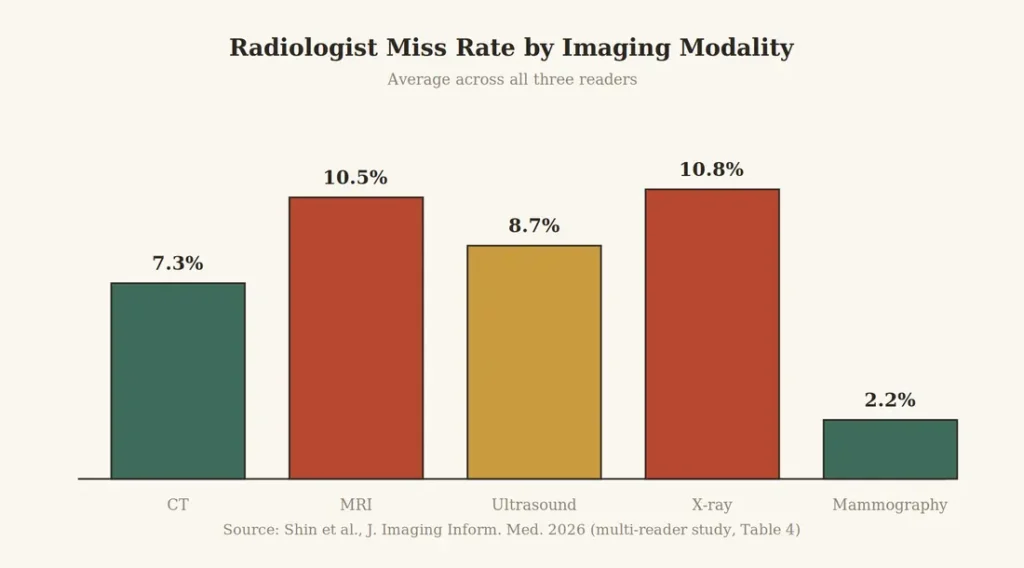
Radiologist miss rates were roughly five times higher for MRI and X-ray than for mammography — a much bigger swing than the difference between individual readers.
Both human miss rates and LLM error rates varied noticeably by imaging modality, and — encouragingly — they moved in roughly the same direction. Mammography, which relies on a highly standardized reporting lexicon, had by far the lowest miss rate (2.2%) of any modality. Complex cross-sectional imaging like MRI (10.5%) and X-ray (10.8%) were the hardest for readers to fully catch. I want to be careful about the claim here: this study didn’t manipulate complexity experimentally, so I can’t say it causes higher error and miss rates — only that more complex, less standardized imaging contexts were associated with both. That’s an association worth taking seriously for deployment planning, even without proof of the underlying mechanism.
The model-level breakdown by modality was even more striking: GPT-4o mini’s error rate spiked in exactly the modalities where it was already weakest overall (18.5% in CT, 20.4% in MRI, 21.0% in ultrasound), while Grok stayed comparatively strong in those same categories (4.2%, 7.1%, 6.0% respectively). Claude 3.5 Sonnet, meanwhile, made zero errors in mammography specifically. That pattern — different models having genuinely different strengths by imaging type, not just different overall averages — is what led us to propose a “modality-specific routing” idea in the discussion: instead of assuming one “best” LLM should handle every imaging type equally well, route each type of report to whichever model has demonstrated the strongest track record for that specific modality. We didn’t test that routing strategy directly in this study — it’s a direction the modality-level results suggest is worth testing, not a validated recommendation.
One reassuring side note: we checked whether a reader’s own subspecialty predicted their miss rate for that same modality (the obvious worry — does the MSK radiologist do worse reviewing chest CTs?), and found no statistically significant association. That’s worth stating carefully: it means an obvious subspecialty-specific blind spot wasn’t detectable in this sample, not that we proved none exists — three readers isn’t a large enough panel to rule that out definitively.
Robustness Checks
A couple of things worth knowing if you’re the type to ask “but does this hold up under scrutiny”: swapping the adjudicated reference standard for a simpler strict-majority-vote rule barely changed anything (reader sensitivity 82.0–97.3% instead of 81.4–96.5%, dual-reader miss rate still under 1%). And restricting the entire analysis to just the 18 clinically significant errors, rather than all 113 deficiencies, told the same basic story: individual sensitivity 88.9–94.4%, and dual-reader review caught all 18 errors in every pairing except one.
Why This Pairs So Directly With My First Study
Read together, these two papers make a fairly complete argument. Paper one showed that these models fail unpredictably, and — critically — fail with no reliable internal warning sign (the calibration deficit); a low confidence score doesn’t mean “check this one more carefully,” because confidence and accuracy are barely correlated at all. Paper two shows that human oversight is a real safety net, but a single reviewer is not a complete one — and that even a two-reviewer safety net’s strength varies by imaging modality and by which model produced the answer.
Practically, if a health system is thinking about deploying LLM-generated patient communication tools, “have a doctor review it first” isn’t a complete safety plan on its own. “Have two independent people review it, with extra scrutiny for complex cross-sectional imaging” is a very different safety architecture — in our dataset it reduced the observed miss rate from 12.4% to 0.6%, though whether that level of redundancy is practical or cost-effective in real clinical workflows is still an open question.
The Honest Limits of This Study
A few worth naming directly: the reference standard came from the same three readers’ own assessments (with senior adjudication of disagreements), not a fully independent external gold standard — because no such gold standard really exists yet for judging patient-facing LLM answers. That partial dependence means this study may overestimate reader sensitivity compared to a truly independent clinical deployment, even though the results held up under a stricter alternative scoring method. Only three readers were included — enough to show that individual variation exists, but not enough to generalize to “radiologists as a population.” These results describe how these three readers performed on this task; a larger panel would be needed to say anything more general about detection rates across the specialty. The dataset was single-center and English-only. And, same as my first study, model behavior evolves quickly — these results reflect the specific model versions available when the study was run, not necessarily what today’s versions would do.
Full Citation
Shin, C. et al. Radiologist Detection of Deficiencies in LLM-Generated Patient Communications About Radiology Reports: A Multi-Reader Study. Journal of Imaging Informatics in Medicine, 2026. Available at: link.springer.com/article/10.1007/s10278-026-02109-5
This is the second entry in my Paper Reviews series — a direct companion to my first post on the calibration deficit and Metadata Paradox in LLM-generated radiology communication. Together they’re the closest thing I have to a complete answer, for now, to the question “is this actually safe to deploy?” — and the honest answer is: not without structured human oversight built in, and, based on these findings, that oversight may need to get more deliberate as the imaging modality and the task get more complex. That’s the question I keep coming back to as AI gets pulled deeper into medicine — not whether to use it, but how to build the guardrails that make it trustworthy — and it’s the direction I plan to keep researching.
This one’s personal — it’s my own peer-reviewed research, published this year in Healthcare. I’ve spent most of this blog reviewing other people’s work and other people’s technology. This time I get to walk you through mine. Here’s where it actually started. Ordinary people are already asking AI chatbots questions about their own medical information…
KHF 2026 — the K-Hospital + HealthTech Fair — was held this week at COEX in Seoul, and I made a point of pre-registering and going. I studied digital healthcare myself, and I wanted to see with my own eyes where Korea’s medical health-tech industry actually stands right now, beyond the press releases. One honest…
The MIMIC-IV dataset is the quiet, unglamorous foundation behind both of my published papers. Both of my papers — the one on whether LLMs can safely explain radiology reports, and the follow-up on whether radiologists can actually catch it when they can’t — used the same underlying data source. I’ve referenced it in passing in…
Today I was at COEX for MEeT 2026 — something a little different from my usual beat. Not a trade show floor, but a conference specifically about the messy, unglamorous process of turning a clinical idea into an actual company. This was its first-ever run. I want to be upfront about why this one hit…