KHF 2026 — the K-Hospital + HealthTech Fair — was held this week at COEX in Seoul, and I made a point of pre-registering and going. I studied digital healthcare myself, and I wanted to see with my own eyes where Korea’s medical health-tech industry actually stands right now, beyond the press releases.
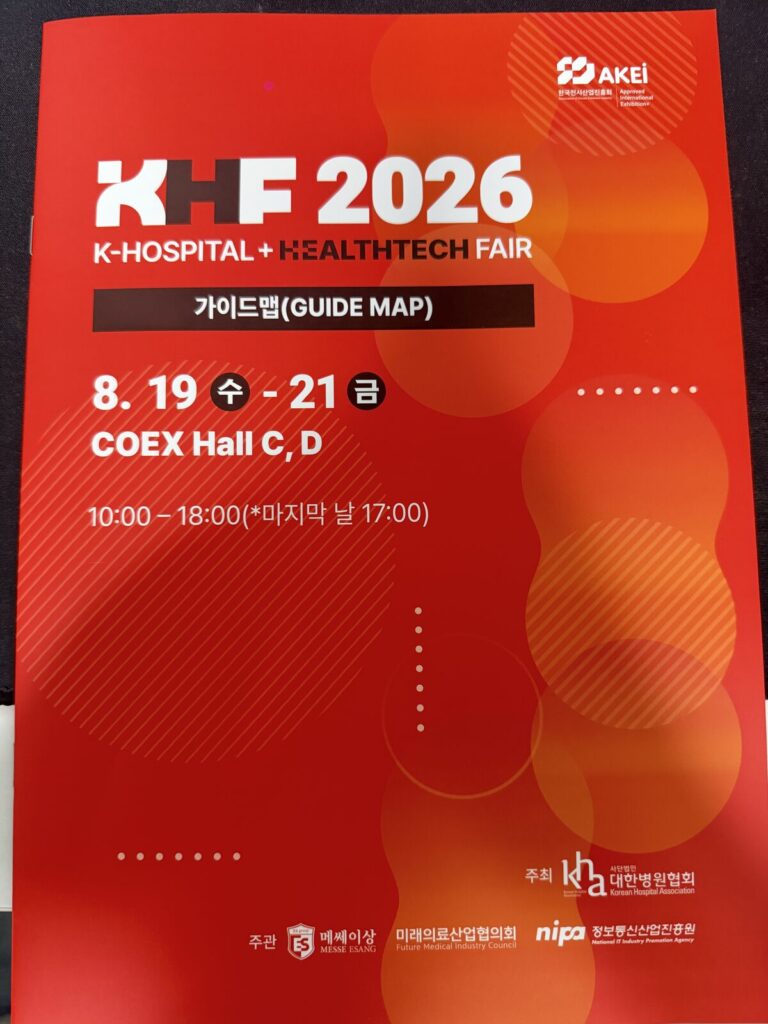
KHF 2026 — K-Hospital + HealthTech Fair, held August 19–21 at COEX Hall C, D.
One honest caveat up front: my registration was the free general-admission type, which gets you into the exhibition floor — not the paid seminar track. So everything in this post is either (1) what I actually saw and heard walking the booths and talking to company reps, or (2) trends I picked up simply by reading the seminar schedule boards posted around the venue, without sitting in on the talks themselves. I’ve kept those two clearly separate below, because I think the second part is actually a useful trick on its own: you don’t have to attend 60+ sessions over three days to see what an industry is currently obsessing over. The program titles alone tell you a lot.
(Quick practical tip if you’re planning to go next year: general exhibition access is free with pre-registration, but most individual seminar sessions need separate, often paid, sign-up. Decide which one you actually want before you go.)
About KHF 2026
KHF 2026 ran August 19–21 at COEX Halls C and D, hosted by the Korean Hospital Association (대한병원협회) and organized with backing from Korea’s Ministry of Health and Welfare, the Ministry of Science and ICT, NIPA, and KHIDI. The organizers bill it as Korea’s largest digital healthcare exhibition specifically — this year’s edition brought together roughly 300 companies across 500 booths, plus 32 separate seminars and conferences running alongside the exhibition. (Worth noting: it’s not the largest medical/hospital trade show in Korea overall — general medical-device fairs like KIMES run considerably bigger — but within the digital-health-and-hospital-AI niche specifically, this is the flagship event.) This year’s theme, printed on nearly every banner in the building, was “The Intelligent Hospital” — AI and robotics driving hospital innovation.
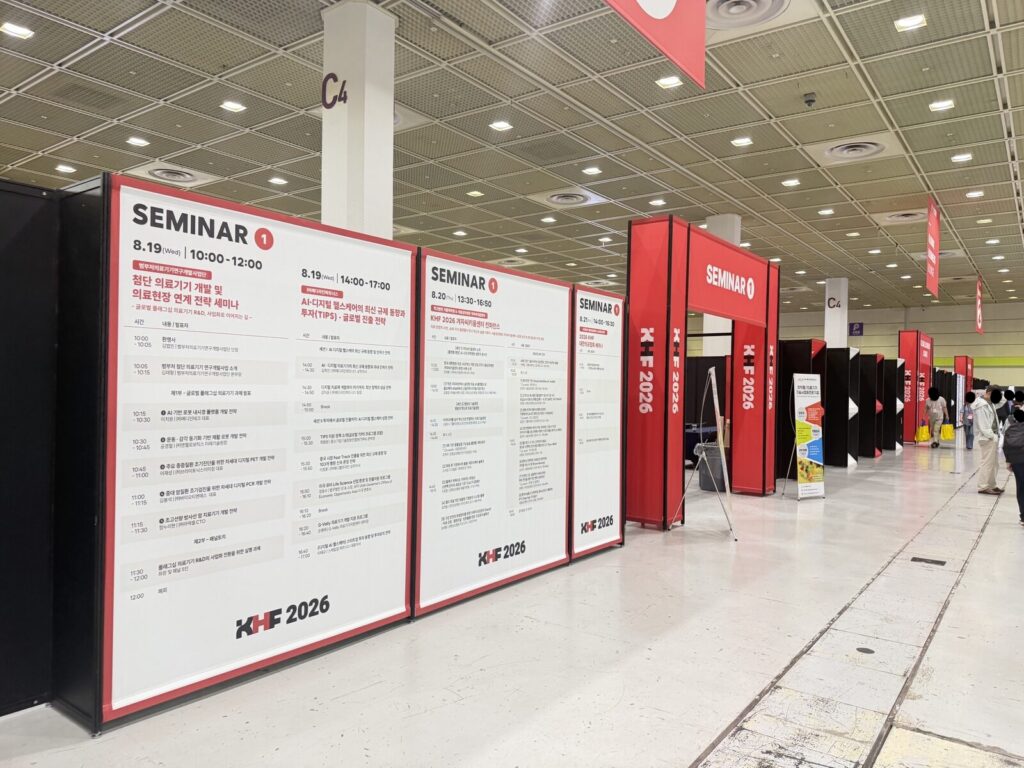
The seminar hall wing at COEX — I didn’t attend these tracks, but the boards lining this corridor turned out to be a trend report in themselves.
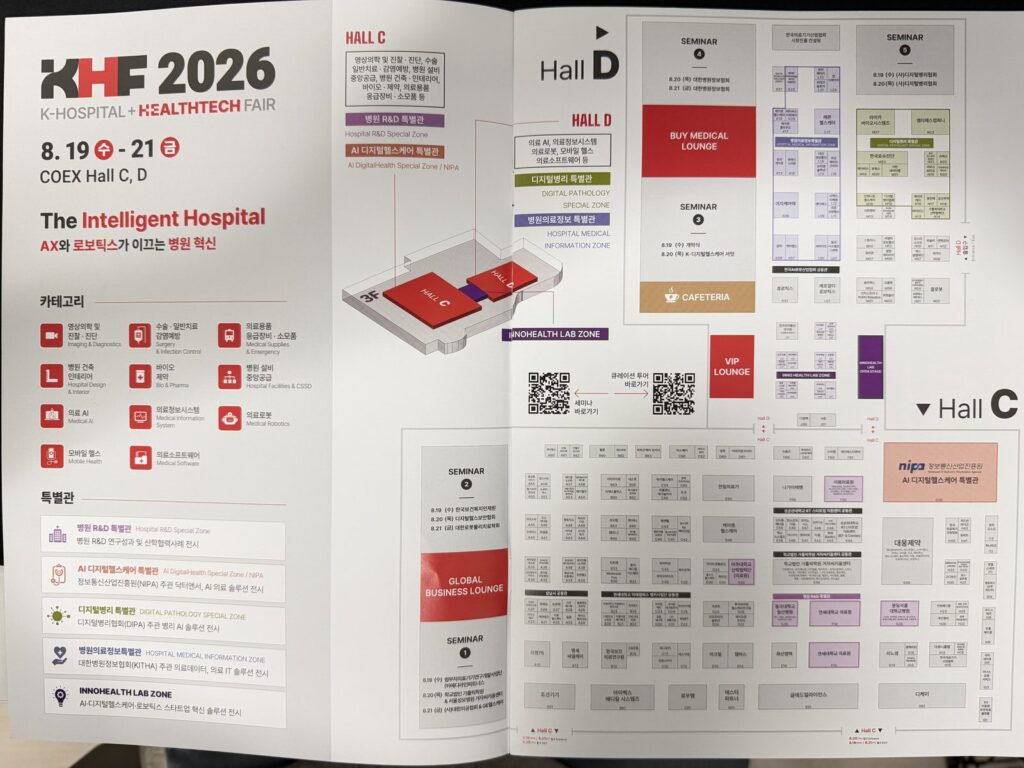
The exhibition floor was organized into five special zones, which is itself a decent map of where the industry’s attention currently sits: a Hospital R&D Special Zone, an AI Digital Health Special Zone, a Digital Pathology Special Zone, a Hospital Medical Information Zone, and an InnoHealth Lab Zone for startups.
What I Actually Saw: A Few Hours on the Exhibition Floor
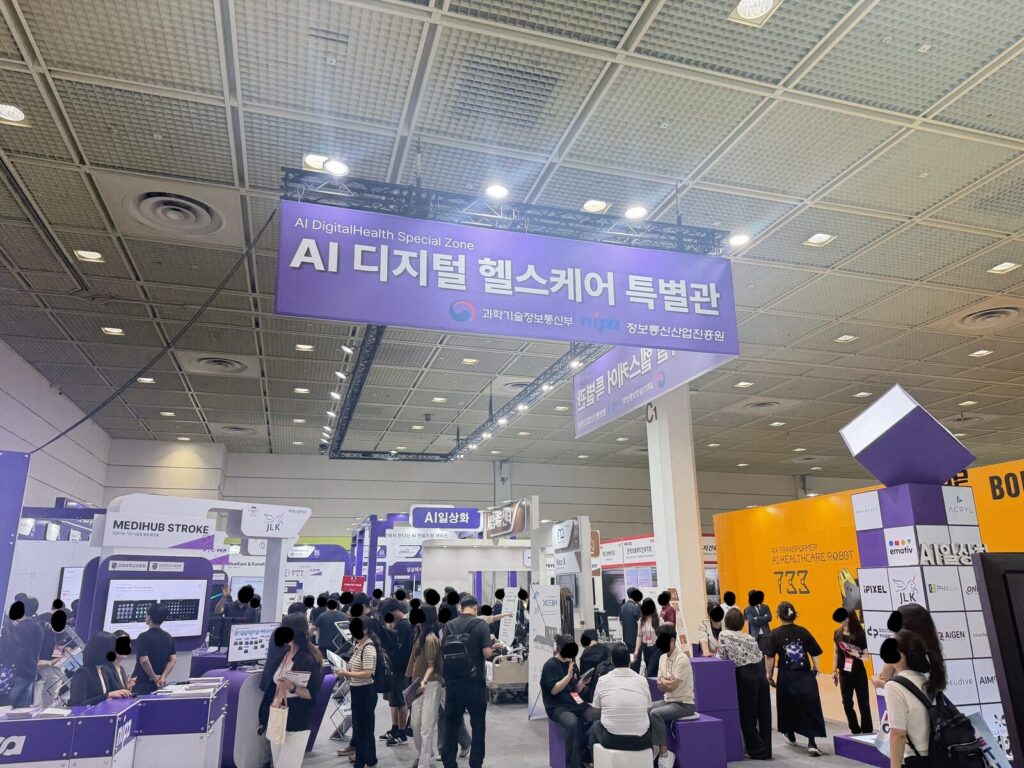
This is the part I can speak to firsthand. The AI Digital Health Special Zone was by far the busiest area of the whole fair — crowds three and four people deep at some booths, which is a decent proxy for where visitor (and probably investor) attention is concentrated right now.
The AI Digital Health Special Zone — the busiest corner of the exhibition floor by a clear margin.
A few things I noticed just by talking to booth staff and picking up their materials:
Stroke and imaging AI had real presence, not just as a concept slide but as actual deployed software — a company called MEDIHUB Stroke was demonstrating a clinical stroke-detection tool, and several neighboring booths (JLK among them) were running similar diagnostic-imaging AI live on-screen for visitors.
“Physical AI” wasn’t just a buzzword on a banner — there was an actual four-legged AI healthcare robot on the floor drawing a steady crowd all afternoon, alongside smaller booths showing robotics for logistics and patient-adjacent tasks inside hospitals.
The pamphlet stack tells its own story. I walked out with brochures ranging from consumer-facing health apps to hospital-integration software to robotics — a genuinely wide spread, which matched the feel of the floor itself: this isn’t one narrow niche, it’s a whole industry restructuring itself around AI and digital tools at once.
Talking to reps directly was more useful than any brochure, honestly — several were happy to walk through a live demo on the spot if you looked interested for more than ten seconds, which is a good reason to actually go to these things in person rather than just reading about them afterward.
The exhibition floor map from the official KHF 2026 guidebook, showing how the special zones were laid out across COEX Hall C and D.
Reading the Trends Off the Schedule Board (Titles Only)
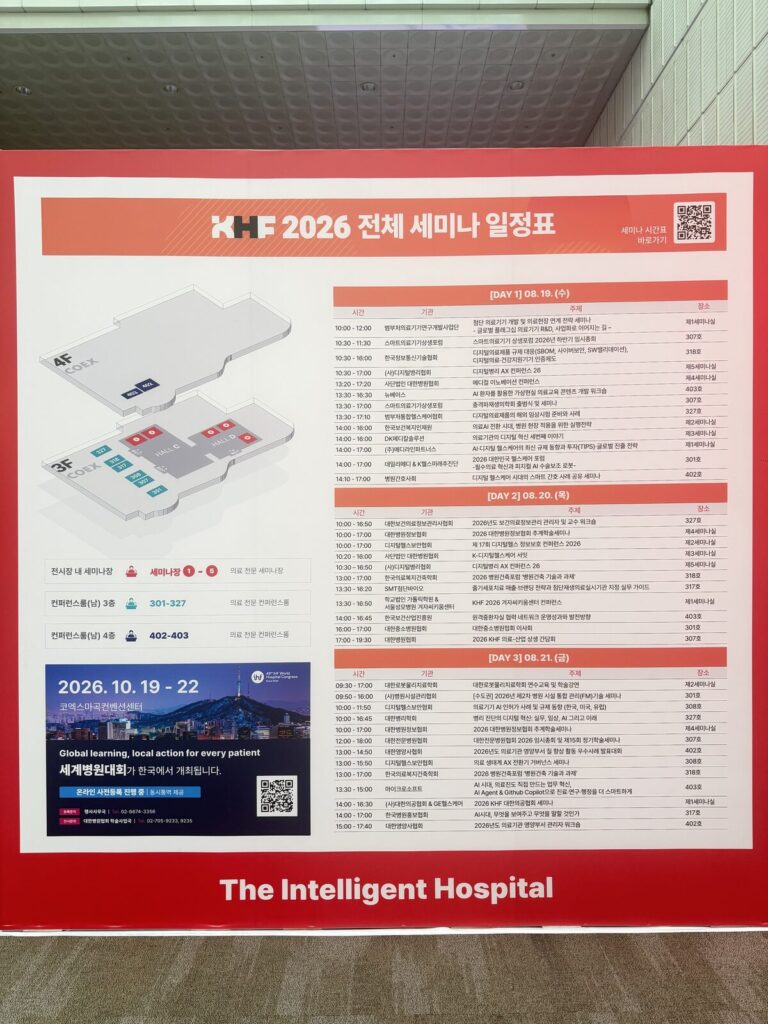
I didn’t sit in on any of the seminar tracks, but the schedule boards mounted throughout the venue list every session’s title, host organization, and speaker — and just scanning through them for a few minutes was genuinely revealing. A few patterns jumped out:
AI as clinical co-pilot, increasingly built by clinicians themselves. One full session, hosted with a hospital’s own innovation center, was titled around nurses building their own tools — with talk titles referencing an AI clinical-workflow assistant, an AI-driven ER intake questionnaire, a 24-hour home palliative-care monitoring tool, and a low-friction patient-transport system, several explicitly credited to nursing staff as co-developers. Whether or not the tools work exactly as billed, the fact that hospitals are running entire conference sessions around staff-built AI tools — instead of only vendor pitches — says something about where adoption pressure is actually coming from.
From “diagnosing AI” to “acting AI.” A session hosted with GE HealthCare used almost that exact phrase as its title — the shift from AI that flags something on a scan to AI that takes the next step in a workflow. Paired with the robotics I saw firsthand on the floor, “Physical AI” (robotics + AI decision-making combined) is clearly the framing the industry has settled on for 2026.
Care is expanding past the hospital’s front door. Several session titles pointed to post-discharge home monitoring, XR-based virtual medical training platforms, and portable diagnostic devices meant for use between hospital visits rather than during them — a “continuum of care” pattern rather than a hospital-centric one.
Digital pathology got serious, international billing. It had its own dedicated zone and a multi-day seminar track — more real estate than I expected. One listed session had Kaiser Permanente presenting on their own digital pathology transformation, alongside Korean-side sessions on scaling AI-native pathology infrastructure. Worth noting as a “read the title, go look this up yourself” recommendation if it’s relevant to your work.
The regulation-and-funding track is where the real signal is. One full-afternoon session was titled around the latest regulatory trends, TIPS investment matching, and global-expansion strategy for AI and digital healthcare companies — covering topics like domestic approval pathways for AI-based medical devices, a fast-track regulatory route into China aimed at a cohort of 103 hospitals, and a session presented directly by Utah’s Governor’s Office of Economic Opportunity courting Korean health-tech companies to expand into the US through that state specifically. If you’re trying to gauge where capital is actually flowing in this sector, this track’s title list alone is worth searching up afterward.
Hospitals are pairing AI-agent adoption with AI-agent security. A session on GitHub Copilot and “AI Agent” tooling for hospital software developers ran on the same schedule as a full parallel security conference covering zero-trust architecture and AI-agent-specific risk. Seeing both tracks in the same building, same week, is a decent sign that at least some of this industry is treating AI adoption and AI risk as one conversation rather than two.
The full three-day seminar schedule board. I didn’t attend these talks — my registration was exhibition-only — but reading through 60-plus session titles turned out to be a fast, honest way to see what the industry is currently talking about.
Takeaway
Walking out, my overall impression wasn’t “healthcare is being automated” — it was that Korea’s hospital system is being re-architected in layers at the same time: clinical staff building their own AI tools, robotics moving from diagnosis into action, care extending past the hospital walls, and — based purely on session titles — a genuinely serious regulatory and funding apparatus underneath it all pushing companies toward the US and China rather than keeping them domestic. That combination is worth watching whether you’re a clinician, a founder, or just someone trying to understand what “AI in healthcare” concretely looks like on the ground in 2026 — and you don’t need a seminar pass to start picking up on it. A few hours on the exhibition floor, and a slow walk past every schedule board, gets you most of the way there.
This is part of an ongoing series of firsthand looks at Korea — its systems, its industries, and what it’s actually like to navigate them. If you found this useful, let me know in the comments what part of Korea’s health-tech or hospital system you’d like covered next.
Today I was at COEX for MEeT 2026 — something a little different from my usual beat. Not a trade show floor, but a conference specifically about the messy, unglamorous process of turning a clinical idea into an actual company. This was its first-ever run. I want to be upfront about why this one hit…