Oktoberfest Seoul 2026 wasn’t what I expected. I’ve seen plenty of “Oktoberfest” pop-ups at bars around Seoul over the years — a few German beers on tap, some sausages, done. This one was different, and it’s worth explaining exactly why before getting into what it was actually like.
Oktoberfest Seoul 2026 is the first festival in Korea to receive official licensing from the city of Munich to use the Oktoberfest name. That’s not a marketing flourish — Munich actually controls the name, and this was the first time a Korean event cleared that bar. It ran September 12–21 at 문화비축기지 (Culture Reservoir Park) in Mapo, a genuinely interesting venue in its own right: a former oil storage facility from the 1970s that Seoul converted into a cultural space, with the old industrial storage tanks still standing around the festival grounds. Worth a visit even outside festival season if you’re into that kind of adaptive-reuse architecture.
By the numbers: roughly 60,000 people came through in just the first five days, with organizers expecting well over 100,000 by the time it wrapped. FC Bayern Munich ran an official pop-up booth. The German Embassy, the Goethe-Institut, and DAAD all had presence on-site with actual study-in-Germany information booths, not just decoration.
Step One: Fuel Up Before You Go (An Actual Tip, Not Just a Detour)
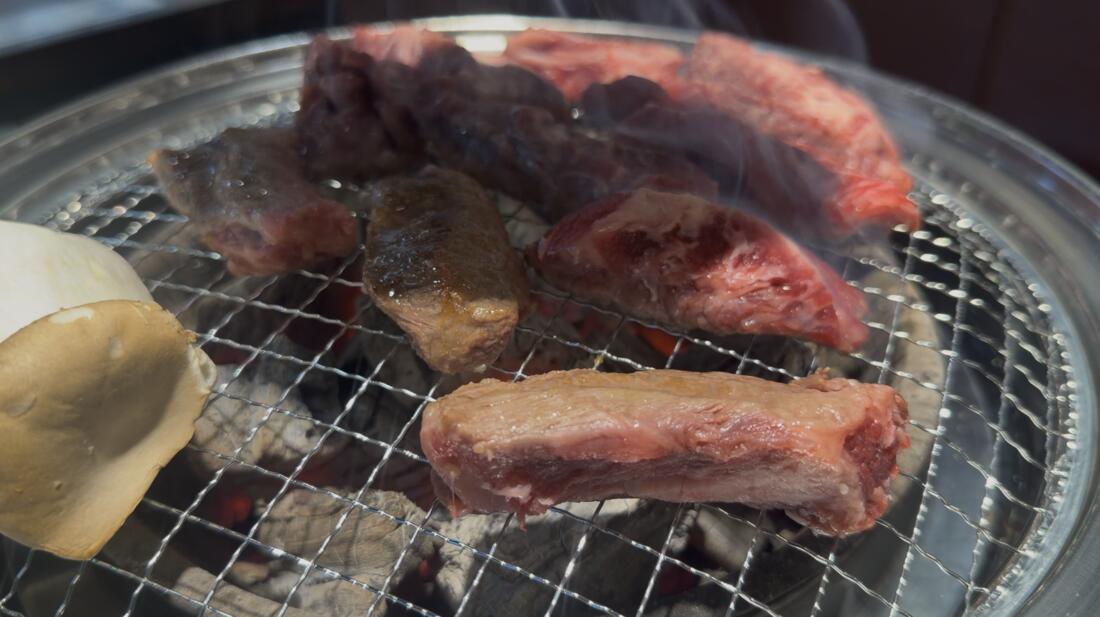
Before heading to the festival, I stopped for lunch at 우마주 (Umaju), a Korean BBQ short rib place — and this is worth mentioning specifically because it’s a nationwide franchise, not a one-off restaurant, so if you’re traveling anywhere in Korea, there’s a decent chance there’s a branch near you.
Grilled short rib at Umaju — a solid, no-nonsense pre-festival meal, and a nationwide chain worth knowing about.
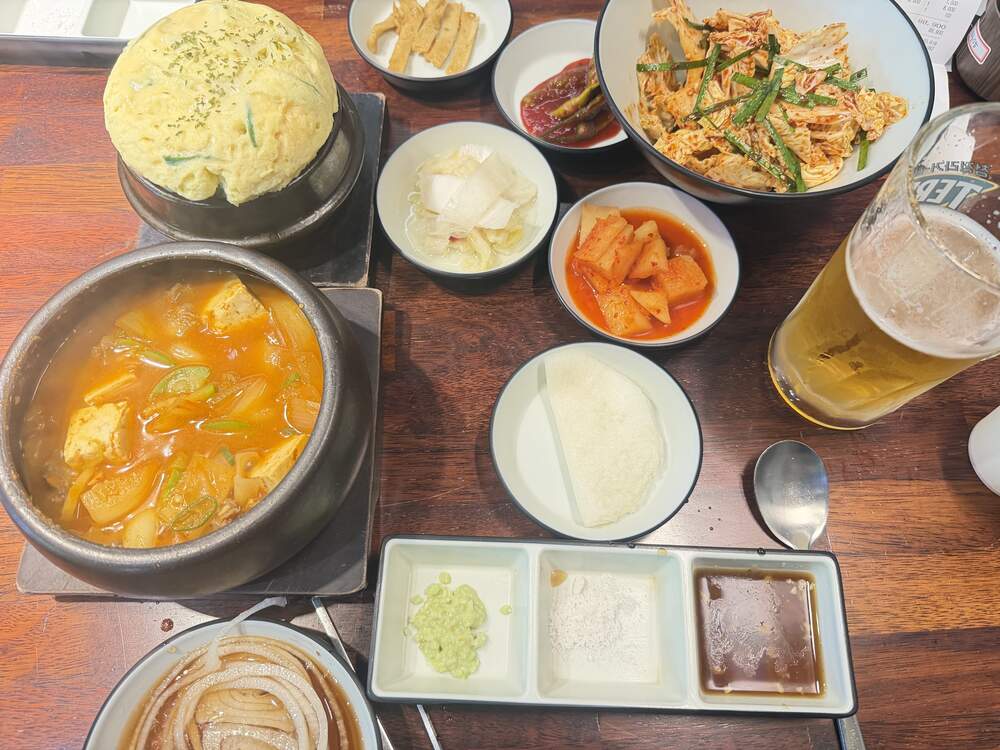
The full table — soft egg soufflé, sundubu-style stew, and a solid lineup of banchan.
Practical logic here: a beer festival with 60,000+ people means long lines for actual food once you’re inside. Showing up already fed, planning to treat the festival food as tasting portions rather than a full meal, made the whole afternoon less stressful.
Inside the Tent
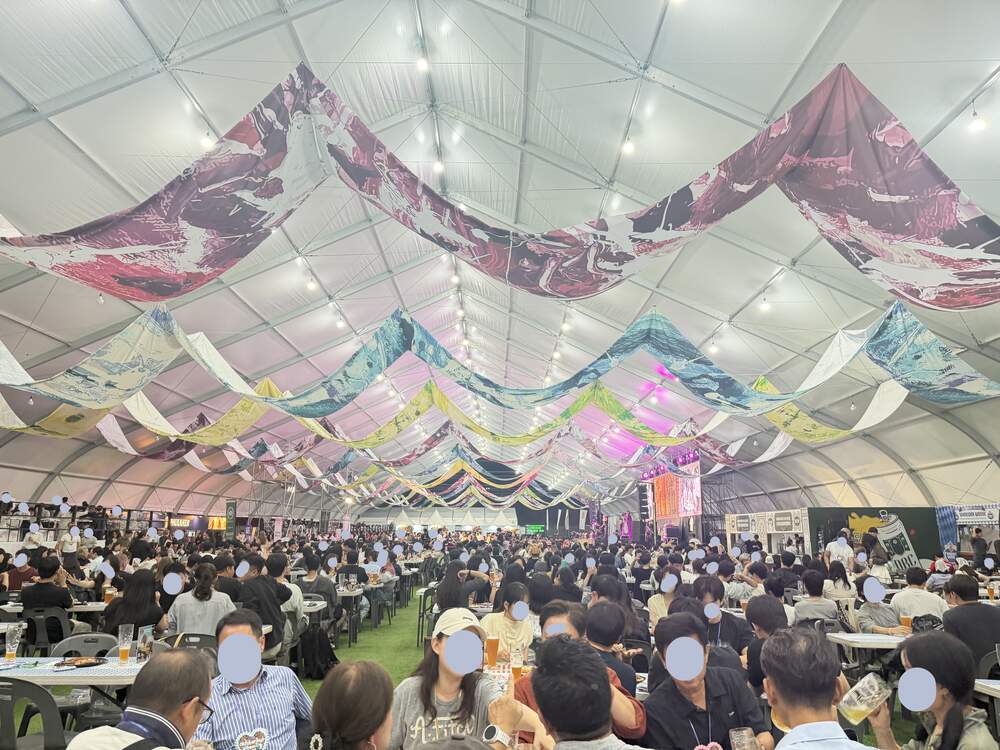
The main tent, mid-afternoon — already packed, with a live band setup at the far end and Bavarian-print bunting overhead.
This photo doesn’t fully capture it, but the tent is genuinely large — long communal tables, a stage running live brass band sets throughout the day, and the specific energy of a few thousand people singing along to “Ein Prosit” (the traditional Bavarian toasting song) every time the band cues it up. If you’ve never been to an actual Oktoberfest, this is a legitimately close approximation, not a watered-down version.
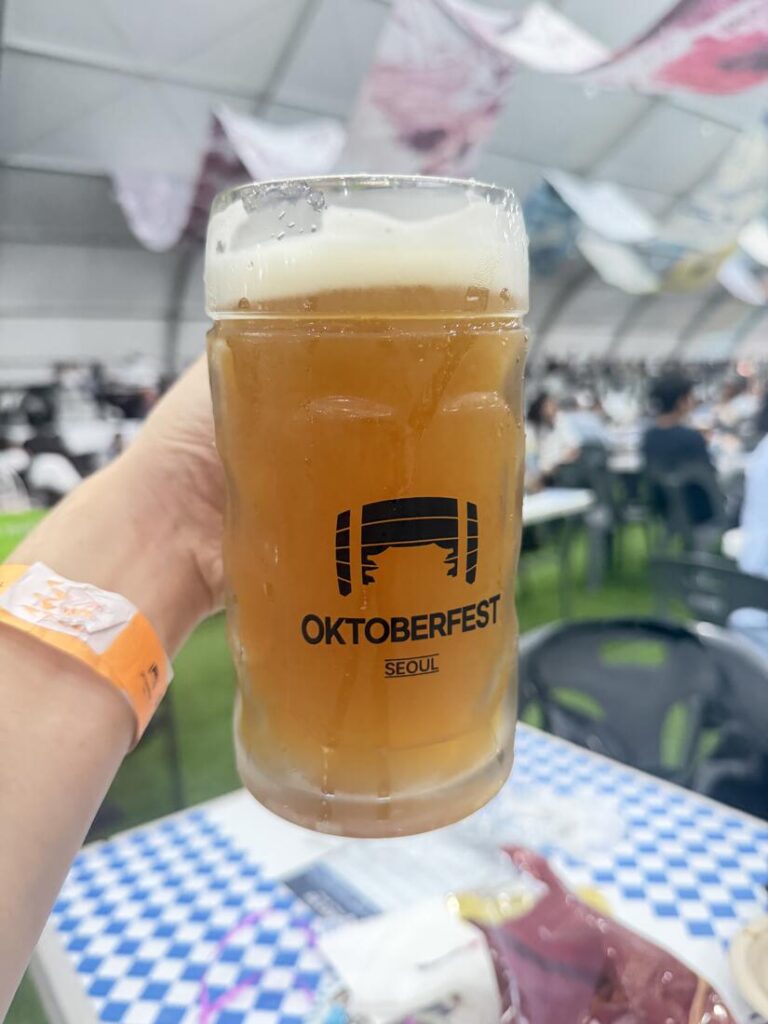
The official festival mug — worth grabbing early, since these are part of the actual Oktoberfest tradition, not just festival merch.
The Food: Genuinely Authentic, With One Very Korean Twist
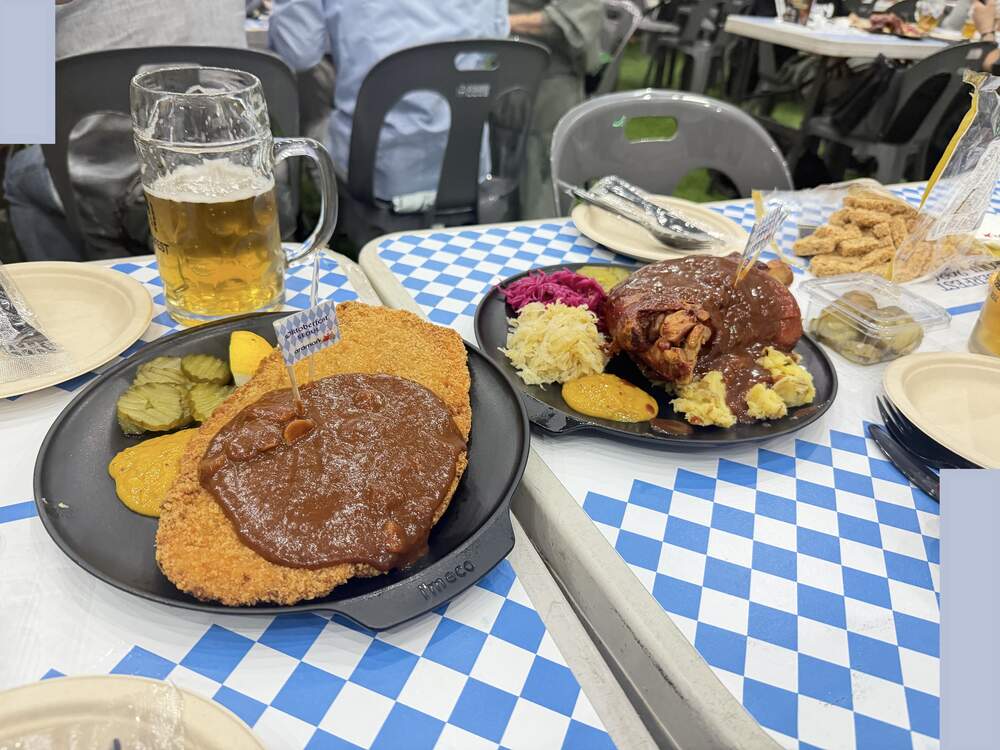
The German food lineup was the real deal — Paulaner and Krombacher on tap, proper Schweinshaxe (pork knuckle) with sauerkraut and gravy, pretzels, schnitzel.
Schnitzel and Schweinshaxe on the classic blue-and-white checkered tablecloth — as close to a Munich beer hall as I’ve found in Seoul.
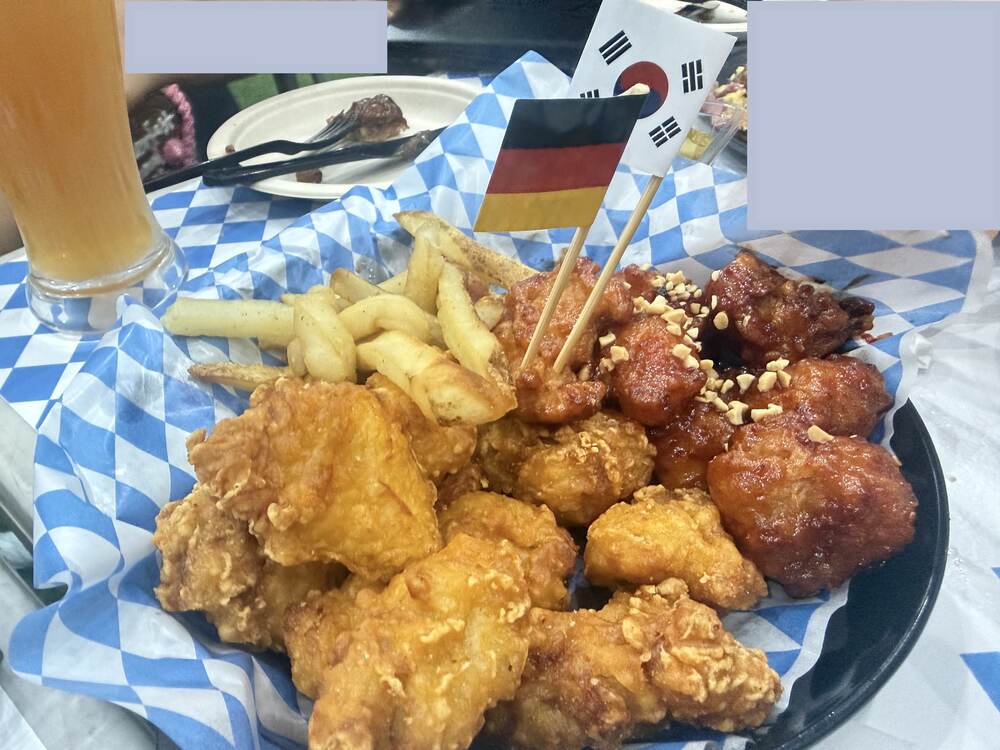
But the moment that actually summed up the whole event for me was this:
Korean fried chicken, served at a German beer festival, marked with both flags. This is exactly what ‘cultural exchange’ looks like in practice, not just in a press release.
K-fried chicken, sitting right there on the menu next to the schnitzel, with a German flag and a Korean flag both stuck in it. Nobody was treating this as a gimmick — it was just what was actually being served and actually being eaten, table after table.
The Practical Bit
If Oktoberfest Seoul runs again next year (and with 60,000+ visitors in the first five days alone, it’s hard to imagine it won’t), a few notes for planning ahead:
Use Kakao Map‘s event-specific overlay, not the regular map. The festival had its own dedicated layer showing booth locations, real-time wait times, and menu availability — genuinely useful for navigating a crowd that size. If you haven’t used Kakao Map for something like this before, it’s a good example of why it consistently beats Google Maps for Korea-specific, real-time local information.
Eat before you go, or plan for festival food to be tasting portions, not a meal — the lines get long once the tent fills up.
Go on a weekday afternoon if you can. We went before peak crowds built up, and it was already substantial by early afternoon; I’d expect weekend evenings to be considerably more packed.
This is part of my ongoing series on real experiences in Korea — practical notes from places I’ve actually been, not just listicle summaries. If you made it to Oktoberfest Seoul 2026 too, I’d love to hear what stood out to you.
KHF 2026 — the K-Hospital + HealthTech Fair — was held this week at COEX in Seoul, and I made a point of pre-registering and going. I studied digital healthcare myself, and I wanted to see with my own eyes where Korea’s medical health-tech industry actually stands right now, beyond the press releases. One honest…
I’m a Seoul native, and lately I don’t have to look far to see it: the growing wave of global interest in K-culture has brought more international visitors to my city than ever before. Seoul is where I spend most of my daily life, and these days it’s common to hear several different languages on…
I promised at the end of my subway post that I’d cover this next, and I think it might actually be more important than the subway post itself. You can learn how a turnstile works in thirty seconds. Figuring out why your phone isn’t giving you directions while you’re standing on a street corner with…